
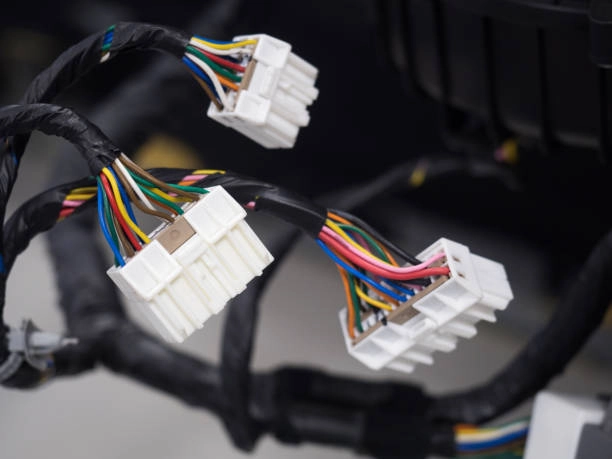
Automotive wire harness tape rarely fails for one dramatic reason. Heat is slightly higher than expected. A harness rubs against a bracket for thousands of kilometers. An operator wraps too tightly. The tape looks fine at the end of the line, then starts lifting weeks later.
Selection should begin with the actual harness location and service conditions, not color, thickness, or price.
What Does Automotive Wire Harness Tape Need to Withstand?
A vehicle wiring harness moves, vibrates, heats up, cools down, and sits close to brackets, fluids, plastics, and other cables.
Inside the cabin, low noise may matter more than extreme heat resistance. Near the engine, heat aging, abrasion, oil exposure, and adhesive stability become more important. Door harnesses face repeated flexing.
A tape that works behind an instrument panel may be a poor choice under the hood.
1. Choosing the Wrong Tape for the Temperature Range
Temperature failures are not always immediate. The adhesive may slowly soften, edges may lift, or the wrap may creep along the bundle.
Engine bay harnesses are a common example. A moderate temperature tape can survive assembly and short testing, then move after repeated hot soak cycles. Some adhesive systems show the opposite behavior and become hard or brittle after prolonged heat aging.
Selection should use the real service temperature, including continuous exposure and short peaks. For hotter zones, PET cloth or other high temperature wire harness tapes are often safer than general purpose PVC tape. Adhesive choice matters just as much.
2. Insufficient Abrasion Resistance
Abrasion damage is usually local. A harness may be protected over nearly its entire length and still fail where it touches one stamped metal edge.
Typical contact points include brackets, housings, body panels, clips, and adjacent cable bundles. Once the backing wears through, cable insulation becomes exposed.
High friction areas need abrasion resistant wire harness tape with enough mechanical strength for that location. PET cloth tape is often selected because its woven backing handles rubbing better than softer film constructions.
Routing should also be checked. Tape cannot compensate indefinitely for poor mechanical layout.
3. Poor Adhesion or Tape Unwinding
When tape unwinds, the adhesive is usually blamed. Sometimes correctly.
Cable jackets can carry dust, oil, plasticizer, or release agents. Excessive wrapping tension creates another problem: the tape is installed under stress and later tries to recover. Edges lift, overlaps open, and end wraps loosen.
Heat and humidity make marginal adhesion worse.
Test the tape on the actual cable jacket, not only on a steel test panel. Keep wrapping tension and overlap consistent, and apply to reasonably clean, dry surfaces. A tape with strong laboratory peel values can still perform badly on a difficult cable surface. Substrate compatibility matters more than one number.
4. Using the Wrong Tape Material for the Application
There is no universal “best” automotive wire harness tape. Backing material changes how the tape wraps, protects, and behaves after installation.
The choice should follow the harness location and the failure mode that matters most.
PVC Wire Harness Tape
PVC wire harness tape is useful for general bundling, flexible wrapping, color identification, and electrical applications. It conforms well around irregular bundles.
It should not automatically be pushed into higher temperature or high abrasion zones simply because it is easy to apply.
PET Cloth Tape
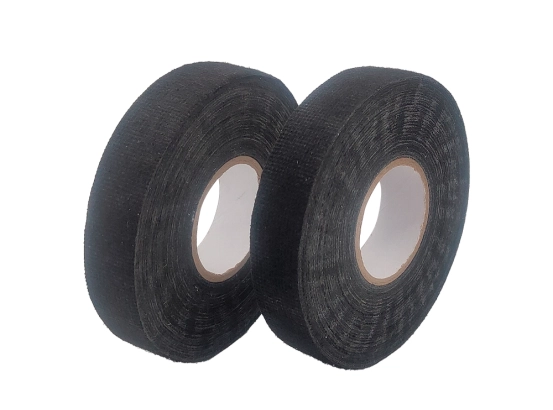
PET cloth tape is a stronger fit when abrasion resistance and mechanical protection are important. It is commonly used where harness sections face rubbing, vibration, or more demanding installation conditions.
Depending on the construction, it can be stiffer than PVC. That matters around tight bends and small branches.
PET Fleece Tape
PET fleece tape addresses a different problem. Its soft structure helps with cushioning, noise reduction, and anti-rattle performance.
Interior harnesses behind dashboards, door panels, and trim parts are typical applications. A hard wrapped bundle tapping against plastic can create a noise that appears only on rough roads. Fleece can reduce that risk.
Temperature, abrasion, flexibility, noise behavior, and location should drive the material choice.
5. Incorrect Wrapping and Installation
A good tape can be ruined by a poor wrapping process.
Uneven tension creates inconsistent bundle stiffness. Excessive stretching can cause shrink back. Too little overlap leaves gaps. Wrinkles create lifting points, especially around branches and connectors. End termination deserves attention as well; many failures begin at the final wrap.
Application temperature matters too. Tape applied in a cold workshop may not wet out the cable surface as expected.
Standardized wrapping instructions and a short production trial are worth the effort. A small process check is cheaper than reworking finished harnesses later.
6. Ignoring Long Term Aging and Environmental Exposure
Initial tack is a poor predictor of long term automotive performance.
A tape can feel excellent during hand application and still lose adhesion after thermal cycling, humidity, oil contact, or prolonged heat. This is especially relevant near powertrain components and other concentrated heat sources.
Aging tests should reflect the real environment as closely as practical. Temperature resistance, chemical resistance, adhesion retention, and backing integrity all matter.
Tapes that look almost identical on day one often separate clearly after aging. Realistic sample testing is more useful than comparing catalog claims alone.
How to Prevent Automotive Wire Harness Tape Failure
Tape selection works better when the application is described in engineering terms.
Before choosing a wire harness tape, evaluate:
- Operating temperature
- Harness location
- Required abrasion resistance
- Noise reduction requirements
- Cable jacket material
- Chemical and moisture exposure
- Required flexibility
- Application method
- Long term aging performance
- OEM specific dimensions, colors, and performance requirements
The tape needs to fit the process as well as the vehicle.
Choosing the Right Wire Harness Tape with QKD Tape
QKD Tape manufactures adhesive tape solutions for automotive and industrial applications, including PVC tape, PET cloth tape, PET fleece tape, and other wire harness tape constructions.
For custom programs, specifications can be adjusted around width, length, thickness, color, adhesive performance, temperature resistance, and packaging requirements. This is useful when a standard product is close, but not quite right, for a particular harness platform. For automotive manufacturers, harness producers, distributors, and component suppliers, the useful discussion starts with application conditions rather than a part number.
Need help selecting automotive wire harness tape?
Contact QKD Tape with the operating temperature, harness location, abrasion level, cable material, and customization requirements.
FAQs About Automotive Wire Harness Tape
Q: What causes wire harness tape to come loose?
Common causes include contaminated cable surfaces, an unsuitable adhesive system, excessive wrapping tension, insufficient overlap, heat, humidity, or poor end termination.
The cable jacket should also be checked. Some low energy or plasticized surfaces are harder to bond than they appear.
Q: What is the best tape for automotive wire harnesses?
There is no single best tape for every harness.
PVC tape can work well for flexible general bundling. PET cloth is often preferred for abrasion protection. PET fleece is useful where noise reduction and cushioning matter. Temperature, friction, location, cable surface, and installation method should drive the decision.
Q: Is PET cloth tape better than PVC tape for automotive wiring?
For abrasion resistance and mechanical protection, PET cloth is generally the stronger option. For flexible wrapping and many general purpose harness applications, PVC can still be practical and cost effective.
The better material depends on the location. Using PET cloth everywhere is usually unnecessary. Using PVC everywhere can be risky.