
A sign letter feels secure when you press it onto the panel. Ten minutes later, someone lifts the panel onto a trolley. Is the bond ready for that?
A day, perhaps three: that’s the sort of waiting allowance to consider for an acrylic mounting-tape job before you check the timing for the particular grade. We call this resting period double-sided tape dwell time. On the bench, that means leaving the support in place until you’ve checked a matching assembly under the conditions it will actually face. A quick tug with your fingers doesn’t settle it.
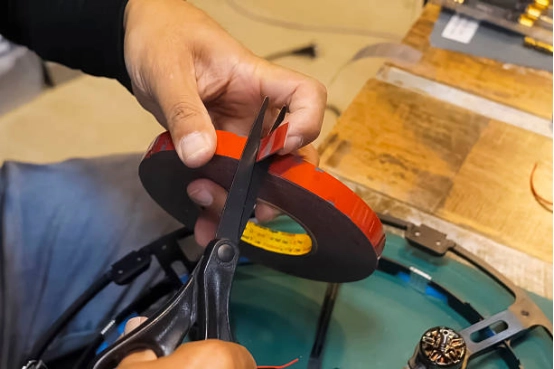
How Long Does Acrylic Foam Tape Take to Set?
That grab you feel on contact is initial tack. Useful, certainly. There is more surface for the adhesive to reach than you might think, even on a sheet that looks smooth. As it flows into those tiny irregularities, contact improves. That’s wet-out. The roller starts the process; putting it back on the shelf doesn’t end it.
| Time After Application | Approximate Ultimate Bond Strength |
| 20 minutes | 50% |
| 24 hours | 90% |
| 72 hours | 100% |
Use this curve to understand why waiting matters. For your acrylic foam tape, build the work schedule around the grade’s own instructions and the results you get on your assembly.
The percentages can be misleading if you turn them straight into weight limits. Half the final bond strength doesn’t give you an approved half-load. Stand the panel up and the joint has a different job from when it was lying on the bench. Catch a projecting edge while carrying it and you add a peeling force as well.
What Changes Tape Dwell Time on the Job?
Before setting the job aside, have a look at the temperature and the contact you’ve made. Extra waiting is a frustrating way to discover that one of these was wrong.
Check the Parts, Not Just the Room
An aluminium panel straight out of a cold van can catch you out here. The heating has been on all morning, so it’s tempting to get started as soon as the delivery arrives. But the panel hasn’t warmed up yet. Worse, moisture may condense on it as you work.
This is a job for a surface-temperature check, followed by enough time indoors for the materials to reach the specified application range. Any condensation needs to be gone before bonding.
The service-temperature rating on a tape can lead to the wrong assumption here. Surviving a cold winter once bonded is different from forming the bond in a cold workshop. An extra night there doesn’t automatically make up for poor contact at installation.
Give the Adhesive Full Contact
It’s worth sorting out the letter positions while the liner is still on. Say one letter sits a little low. You can move it about without worrying about a finger landing on the adhesive, then peel the liner when you’re satisfied. That saves a lot of awkward handling. The panel needs cleaning as well, with a compatible cleaner that has fully evaporated before bonding.
Don’t let the panel flex away underneath the roller. Support it on the bench, then work across the tape’s full length at the pressure required for that grade. It’s easy to roll the centre thoroughly and lift off just before the end. That last bit needs pressing too.
Try the parts together before cutting your double-sided foam tape. If they rock against each other, find out where the gap is. You might have a bent part, or need a different foam thickness. We wouldn’t try to rescue it by stacking whatever strips happen to be left on the bench.
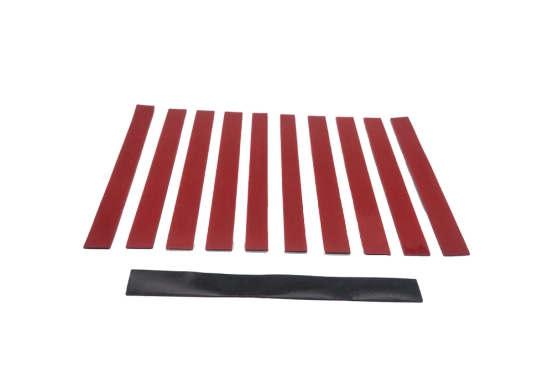
How Do You Check a Tape Bond Before Loading?
Give yourself a few spare parts for a trial before the full batch reaches assembly. Moving a supported panel onto a trolley and putting its newly attached letters under load are different events. Your trial should cover both.
Make Samples That Match the Job
For example, divide matching sign-letter samples into three sets. A convenient scrap of bare metal won’t tell you much about a painted production panel, so keep the finish and tape width the same as the job.
One set comes off the rack for checking after 20 minutes. Leave the others for 24 and 72 hours respectively. Apart from the wait, give them the same treatment; changing the cleaner halfway through would spoil the comparison. A note of the assembly time and part temperature belongs with each set. Take an edge photograph before loading, too.
Resist the temptation to lift a corner and stick it down again for the next check. You’d be testing a disturbed bond. That’s why you made separate sets.
Separate Moving the Part from Loading It
During a transfer trial, support the panel and reproduce the actual movement onto the trolley. Don’t carry it by a newly attached trim piece.
Put the loading samples in their working orientation with a representative load. A pencil mark beside a sample makes slow slipping easier to spot than memory alone. Keep checking with the load still on. The letter may look fine when you let go and have moved by the time you come back.
The same corner lifting in every set would send us back to the fit and preparation. We’d investigate that tape failure before spending another day waiting. Even a successful trial needs repeating before you give the crew a release time. Include the temperatures and exposure expected on the finished job.
Set a Tape Dwell Time Your Crew Can Use
Write down the tape grade and the application conditions alongside the waiting period. Give the crew a clear time for supported handling and another for loading when the process requires it. A label saying only “leave overnight” loses meaning between shifts.
If the schedule leaves little room for waiting, send us the assembly details. Include the two bonding surfaces and the load, plus when the part must leave its support. That is the practical question to resolve before the next batch reaches the bench.
FAQ
Does Double-Sided Tape Dry Like Liquid Glue?
There’s no bead of glue to watch turning dry. With ordinary mounting tape, the sticky layer is already there when you remove the liner. It gets closer contact with the surface as it rests after pressing. From outside, you probably won’t see any change.
Does Pre-Applying Tape Start the Whole Waiting Period?
Suppose you tape the letters on Monday but leave the liner on until Tuesday’s installation. Monday’s work gives the letter side a head start. The panel side gets none of that time; its wait begins when you fit and press the letter on Tuesday.
Can a Heat Gun Shorten the Wait?
We wouldn’t use a heat gun to squeeze a late job into the van. Some grades do benefit from controlled heating, but that calls for an approved temperature and duration. Blowing hot air across the sign gives you much less control over either.
Will Another Day Fix a Lifting Corner?
A corner already lifting deserves a closer look before you leave for the day. Is the part trying to spring back? Was that end pressed down properly? You need to sort that out and fit fresh tape, rather than hope tomorrow’s shift finds it attached.