

Automotive lightweighting now involves more than replacing steel with aluminum. Modern vehicles combine plastics, coated metals, composites, films, and foams in the same assembly. These materials do not always expand or bond in the same way.
Double-sided adhesive tape for automotive assembly offers a practical option for selected joints. It can reduce the need for screws and clips while supporting a cleaner design and faster installation.
Why Lightweight Vehicles Require New Assembly Methods
A lightweight component is not always easy to assemble.
Mechanical fasteners solve some of these problems. They also add hardware and often require holes or reinforced mounting points. This can increase part weight and complicate tooling. Exposed fastener heads may also affect the appearance of an interior component.
Liquid adhesives create different process demands. They may require mixing, dispensing equipment, curing time, and additional cleaning.
How Double-Sided Adhesive Tape Supports Lightweight Assembly
The benefit of tape is not limited to holding two parts together. It can influence part design, installation time, appearance, and the number of components required. The correct construction also helps manage movement between different substrates.
1. Reducing Fastener-Related Weight
Screws, clips, rivets, and washers may seem small. Across a high-volume vehicle program, their combined weight and cost become more noticeable.
A continuous tape bond can replace selected fasteners in interior trim, decorative inserts, badges, protective covers, and cable-management accessories. This may reduce the number of mounting points. It can also reduce the need for reinforced ribs behind a plastic panel.
Consider a door trim insert held by several clips. The clips require matching features in both the insert and the panel. A die-cut tape part may hold the insert without those features, provided the load and service conditions are suitable. The saving may involve more than the clips. The plastic part could become simpler and flatter as well.
2. Bonding Dissimilar Materials
Automotive assemblies often join materials with very different surface properties. A plastic part may meet a coated metal panel. A foam layer may meet a film. A decorative laminate may be applied to a composite surface.
Tape for bonding dissimilar materials can work across these combinations when the adhesive is matched to the substrates. The carrier can also help the joint follow a slight curve or absorb a small gap.
PET tape is often considered when dimensional stability and clean converting are important. Flexible constructions may work better where the parts move or require more conformability. The adhesive chemistry matters as much as the carrier.
Surface preparation also affects the result. A suitable tape cannot overcome oil, dust, release agents, or an incompatible coating.
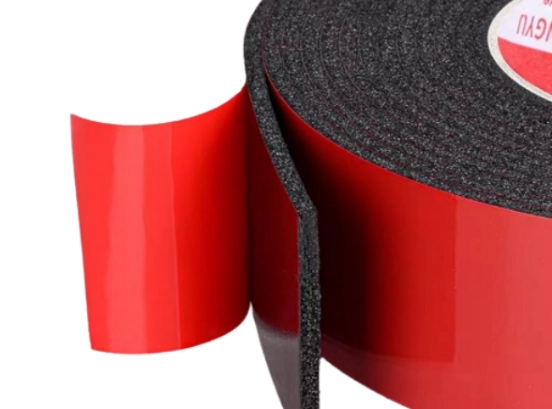
3. Distributing Stress Across the Bond Area
A screw transfers force through a specific point. Tape spreads the load over the bonded area. This can be useful for thin panels and lightweight trim parts.
A well-designed tape joint may reduce localized stress around drilled holes and mounting bosses. It can also help limit cracking or deformation in some plastic components. Joint width, overlap, edge exposure, and application pressure all influence performance.
This is where application engineering becomes important. A stronger tape cannot always compensate for a narrow bond line or poor contact. The joint must be designed around the real load path.
4. Supporting Appearance and NVH Requirements
Hidden adhesive joints create a cleaner surface. There are no exposed fastener heads or visible holes. This matters in dashboards, consoles, door panels, pillar trim, and branded interior details.
Tape can also provide some damping between joined surfaces. In certain applications, that helps reduce minor rattling or buzzing caused by vibration. It is not a complete NVH solution. It can still contribute to a quieter assembly when the parts and tape are properly matched.
Automotive Applications of Double-Sided Tape
Double-sided tape is useful in many non-structural and semi-structural vehicle applications.
Interior trim panels are one example. Decorative inserts, emblems, nameplates, and branding parts are others. Tape can also mount selected dashboard accessories, pillar trim, protective films, and cable-routing clips.
A production engineer may value installation speed as much as bond strength. A pre-cut tape part can be positioned and pressed into place without waiting for a liquid adhesive to cure. That helps maintain a steady line rhythm.
Die-cut parts can also improve placement accuracy. They reduce the need for operators to measure and cut tape during assembly. In a high-volume process, this reduces variation between units.
Choosing the Right Tape for Automotive Assembly
Tape selection should begin with the complete application. The phrase “double-sided tape” covers many different constructions and performance levels.
Substrate compatibility is central. Plastics, painted metals, glass, films, and composites present different bonding conditions. Surface energy and texture can change the result. Paint systems and protective coatings may also affect adhesion.
The required performance may include initial tack, peel strength, shear resistance, impact resistance, and long-term holding power. Temperature cycling deserves close attention. A joint that performs well in a factory may behave differently after repeated exposure to heat and cold.
Thickness affects the design as well. A thicker tape can fill small gaps and absorb movement. A thinner tape may suit a tighter tolerance. PET tape can support stable converting. A more flexible construction may be better for curved parts.
From Prototype to Mass Production: Validation Considerations
The tape should be tested as part of the actual assembly. A peel test on a flat coupon is useful, but it cannot reproduce every production condition.
Validation may include peel testing and shear testing. Static-load testing can show whether the bond holds over time. Vibration exposure helps reveal movement-related failures. Temperature and humidity aging can identify changes in adhesion. Thermal cycling is useful when two substrates expand at different rates.
Trial installation on real painted, molded, or coated components often reveals hidden issues. The operator may struggle with liner removal. The tape may lift at a tight corner. A surface treatment may leave residue. These details matter in production.
Roll quality and die-cut tolerances also affect consistency. Storage conditions can influence adhesive performance before the tape reaches the line. A reliable supplier should support prototype trials and pilot production rather than provide only a standard product code.
Why Work with QKD Tape for Automotive Adhesive Solutions?
QKD Tape serves global B2B customers that need more than a standard roll of adhesive material. Its product range includes double-sided tape, PET tape, PVC tape, masking tape, fiberglass tape, and wire harness tape.
For automotive lightweight assembly, customization may involve width, thickness, adhesive performance, roll length, die-cut shape, liner type, packaging, or application tolerances. OEM and ODM support becomes useful when a component does not fit an off-the-shelf format.
Contact QKD Tape with the component details and production requirements to discuss a customized automotive adhesive solution.
FAQ: Automotive Double-Sided Adhesive Tape
Q: Can double-sided tape replace automotive screws or clips?
It can replace selected fasteners in suitable non-structural or semi-structural applications. The joint must be validated for load, temperature, vibration, aging, and actual surface conditions. Screws or clips may still be necessary for safety-critical parts.
Q: What information should buyers provide when requesting a custom tape?
Useful information includes the substrate types, bonding area, component size, required thickness, operating temperature, chemical exposure, application process, and expected service life. Drawings or sample parts can help the supplier recommend a more accurate construction.