
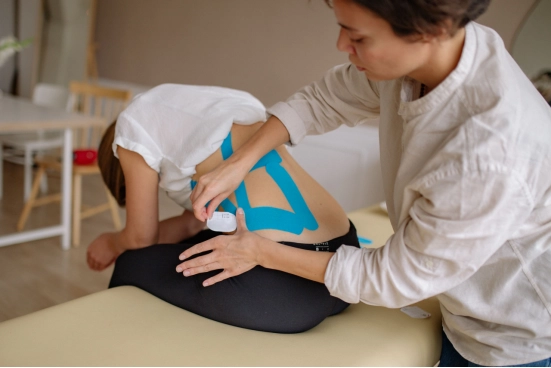
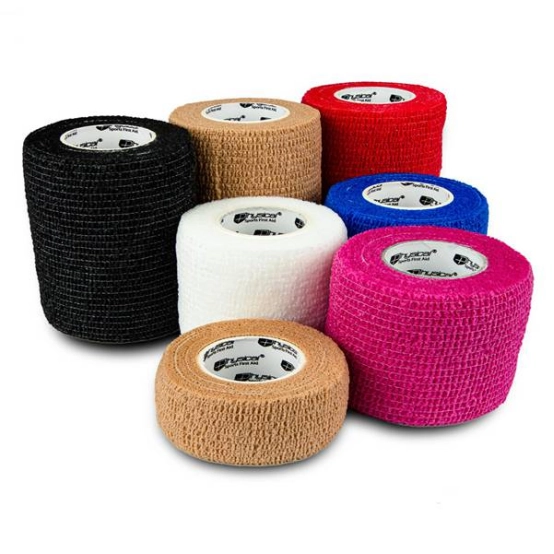
Ask someone to fetch “the stretchy tape” from a clinic cupboard and they might bring back either of these products. In the hand, both give. On the patient, they attach in different ways. Cohesive bandage grips the next layer of the wrap; kinesiology tape needs adhesive contact with skin. For a cohesive bandage vs. kinesiology tape comparison, that is the distinction to settle before talking about price. A spare roll of one won’t necessarily finish a job started with the other.
Both can belong in a clinic. We would be wary, though, of grouping them under one stock description such as “elastic sports tape.” It hides the difference the person opening the packet needs to know.
Where Does Each Tape Actually Hold?
Try a short piece of cohesive bandage against another piece from the roll. Press them together, then separate them. You can feel the grip between the layers without ever putting the material onto skin. During wrapping, the overlap provides that contact around the limb.
With kinesiology tape, you peel away the backing and keep the newly exposed adhesive clean until it reaches the skin. A useful distinction when someone asks for “something that doesn’t stick”: do they mean no adhesive on skin, or do they mean easy removal? Those aren’t quite the same request.
For a compression application, we would spend less time judging softness in the hand and more time checking the specified wrapping method. A soft material can still produce an uncomfortably tight wrap.
What Changes at the Treatment Table?
The two formats create different preparation and removal work. Keep those tasks separate when comparing samples.
Handling a Cohesive Wrap
Take a dressing that needs holding in place without sticking anything to the skin beside it. That’s a reasonable job for flexible cohesive bandage, provided the wrapping method suits the patient. A turn that feels loose is a reason to check the pattern before reaching for another roll or pulling harder.
The patient’s response belongs in that check. If they report numbness, or if the skin changes colour, promptly loosen or remove the wrap and get a clinician’s assessment. Being pleased with a tidy finish is no reason to leave a concerning symptom unchecked.
A removed QKD Tape cohesive wrap should be replaced with a fresh one. It may look perfectly usable on the tray, but appearance isn’t a check of its remaining grip. Count the replacement in your material allowance.
Preparing Skin for Kinesiology Tape
Lotion used earlier in an appointment leaves a job to do before taping can begin. There may still be residue where the strip needs to go. Removing that residue and drying the skin take time, which is easily missed if you time only the application itself. Touching the exposed adhesive while repositioning a strip adds another variable.
Rounded corners are worth the small amount of cutting time, particularly where clothing passes over the strip. As for stretch, leave the anchor ends relaxed. The clinician’s selected method determines what happens between them.
The word “waterproof” doesn’t remove the preparation step. With our waterproof kinesiology tape, allow an hour after application before swimming or showering. A strip applied just before the patient gets wet hasn’t had that interval.
Which Tape Dimensions Matter in a Clinic?
Width is the easy part of the description. A 5 cm roll is 5 cm across. Length takes a little more attention with elastic materials, because a stretched measurement and a relaxed measurement aren’t interchangeable.
Our standard cohesive bandage comes in widths from 2.5 cm to 15 cm. Its 4.5 m length is a stretched measurement. The kinesiology roll is supplied at 5 m, with widths from 2.5 cm to 7.5 cm. Putting those two length figures side by side doesn’t establish which gives more usable applications. You need the measurement basis and the actual material used for each job.
Pack counts need the same care. In a box of our pre-cut kinesiology tape, you get five Y-shaped strips alongside five I-shaped strips. If your method uses a Y and an I together, that box gives five sets. Calling it a ten-application box would double the apparent yield.
It helps to draw the set on the trial sheet. Someone counting loose pieces can then see exactly what the person counting completed applications means.
How Can You Compare Tape Cost Without Mixing Up the Jobs?
We wouldn’t rank cohesive wrap against kinesiology tape by cost per application alone. A cheaper dressing-retention wrap doesn’t answer a requirement for skin-applied strips. Within the same job, however, a roll and a suitable pre-cut shape can make a useful cost comparison.
Say your kinesiology application needs two strips of 25 cm each. A 5 m roll has enough length for ten of these 50 cm sets before trimming or waste. With an illustrative price of $6 for the roll, you would allow $0.60 in material for each set.
Lose one set to a cutting error and the yield becomes nine. The same $6 now works out at about $0.67 per completed application. Nothing about the purchase price changed.
That’s why we’d count discarded pieces during the trial. If preparation time matters, time a few applications with the staff who will use the material. Pre-cut pieces still need positioning, so the cutting step is only part of the time you’re measuring.
Make the Next Tape Trial Specific
Choose a job your clinic sees often enough to repeat during the trial. Follow the application through to removal. The condition of a strip after time under a sleeve is more informative than its appearance just after the backing comes off.
You can send us the application details, including where attachment is needed and what happens during wear. A description of that one recurring job gives us more to work with than “a stronger sports tape.”
FAQ
Can You Reuse Cohesive Bandage?
No, use a fresh QKD Tape wrap. The removed piece can look intact while having lost some of its grip. That’s an easy replacement cost to miss when estimating how long a carton will last.
Is Water-Resistant Cohesive Wrap Suitable for Swimming?
A prolonged swim is outside the intended light-moisture exposure for our cohesive wrap. Tell us if pool sessions are part of the routine so that the material discussion includes immersion, rather than just occasional dampness.
Does Latex-Free Mean Nobody Will React to the Tape?
It rules out latex in the product, not sensitivity to every other ingredient. The patient might already know about a reaction to a previous tape. Ask about that history; remove the material if irritation develops and get clinical advice before reapplying.
Can Kinesiology Tape Replace a Compression Wrap?
Don’t substitute it on the strength of the word “elastic.” An adhesive strip placed along the skin doesn’t reproduce a clinician-selected compression bandage system. Keep the specified treatment method.