
Tail lamp. That’s where a thin unpainted strip can hide when a car comes back from prep. Not across the wide glass; under the small lip beside a fitted lamp. The words “full repaint” leave too much unsaid. Are the door shuts included? Which parts stay fitted? Answer those, and the cover plan starts to take shape.
Where Does Full-Car Masking Usually Fail?
At transitions, not long open surfaces. On a hatchback with the tail lamps still fitted, open the hatch and look under the lamp’s lower lip. There’s a narrow shelf beside the gasket. Cover it before laying the broad sheet. Otherwise you’ll be reaching into a tight gap with the window already covered.
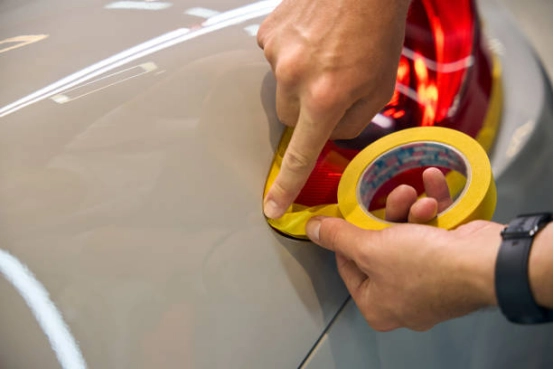
At the paint line, masking paper tape holds a narrow edge against a clean, compatible surface. The film covers the window. The tape closes its boundary; it cannot do the wide job alone.
Which Car Parts Need Their Own Masking Plan?
Draw the line on the job sheet. A parts list won’t show where a piece of film should stop. At the hatch, look under the seal. That is where the paint edge slips out of sight.
| Vehicle Zone | Keep This Clean | Look Closely At |
| Glass and lamps | Faces and surrounding trim | The rubber lip at each corner |
| Doors and hatch | The shut that stays unpainted | The latch recess under the seal |
| Wheels and lower body | Tires and exposed hardware | The return inside each arch |
| Roof and broad panels | The open surface around the work | Film joints near trim |
Two people may split the job. Mark their meeting point. Otherwise one may assume the other closed the small joint between sheets.
Where Should the Masking Film Stop?
One long sheet is tempting. Use it only if the person holding the free end can keep it off the side panel. Leave the curve to a separate piece.
Is the Edge Ready for Tape?
The surface should be through its paint preparation and dry as directed. Sanding dust settles along the trim line, right where tape needs contact. A lamp staying on the car? Close its hidden edge now. After the film is down, your hands will not fit as easily.
How Big a Sheet Can You Control?
Hold the taped edge near the top and let the film follow it. It will try to fold back. With pre-taped masking film, the cover and its adhesive edge arrive joined. That saves a pass on a straight window. At the cowl or wheel arch, split the sheet before it wrinkles. Keep the knife clear of paint.
Which Seams Need Another Look?
Rear-glass corner. Door latch. The return inside the wheel arch. Check each on its own. Press the join at every change in angle. Let the spray travel over the overlap, not into its edge. Step to one side as well; that’s where a lifted lap shows.
On a compact SUV, say the gun travels from front fender toward the rear quarter. Look at the lap from beside that route. Is the edge flat to the spray, or facing it? A quick step around the car changes what you see.
Will the Masking Film Handle Your Paint Booth?
The booth controller reports air temperature. Your film sits on a panel. Those are not the same measurement; the roof and lower body can see different conditions. A correction pass adds exposure.
Our pre-taped masking film for automotive painting includes 60°C and 120°C service-temperature models:
| Models | Listed Service Temperature |
| IPT-101 and IPT-102 | 60°C |
| OPT-201 and OPT-202 | 120°C |
The 120°C label does not set the bake schedule. Compare the roll’s rating with the temperature at the part and the time it spends there. A correction pass adds heat exposure; note both cycles.
Does Anything Move Once the Booth Is Running?
Bring a lamp around the car and move it with you. A fixed beam can miss a curled edge.
- From the gun’s approach, sight along the tape. The edge can disappear when you look straight at it.
- Set the doors and hatch as they will be for spraying. Check the shut once more.
- Put the light low at the wheel arch. The return hides under the lip.
- Start normal booth airflow; watch whether a loose sheet moves toward paint.
- Add the model and removal stage to the work order.
The shadows change between prep and booth. Walk the vehicle there. Moving one strip is a small interruption; repainting a stray line is not.
What Goes on the Next Repaint Sheet?
Keep the vehicle map with the work order. Write down the film model and panel temperature. Add when the mask came off. If an edge lifts, mark the location on the drawing. “Upper left of rear glass” tells the next shift more than “near the hatch.”
If a material choice needs a review, share the panel map and bake conditions with us. Include the part being painted and its booth cycle. We can start there.
FAQ
Remove Trim or Mask in Place?
Taking trim off exposes the hidden edge, though it adds removal and refit time. If it stays on, protect the return as well as the face. A sheet over the face alone leaves a narrow gap.
What Overlap Does the Film Need?
Think about the gun’s direction. Lay the next piece so the spray passes over the lap rather than into its edge. Check that it stays put around corners too.
Is Booth Air Temp the Tape Temperature?
No. One number describes booth air; the other is the model’s service rating. Find out what reaches the masked part and for how long.
Can Pre-Taped Film Handle Every Curve?
It suits broad glass and panels. A deep recess needs more control. When a sheet wrinkles at a curve, cut a smaller section instead of pulling it flat.