
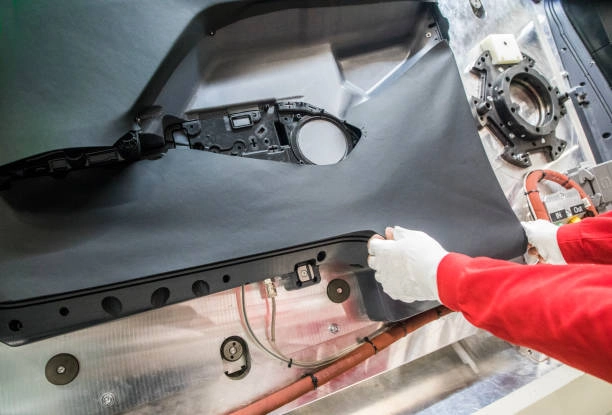
Automotive interior trim includes door panels, dashboards, decorative strips, foam, fabrics, and plastic components. These parts need strong hold. The hold must keep the same look. Adhesive tapes give cleaner assembly. They cut visible fixing points. They make production simpler than screws or rivets.
Picking the right adhesive tapes for automotive interior trim depends on the substrate, temperature, load, surface shape, and production process. Some jobs may need tissue tape. Others work with PET tape. Foam tape fits certain cases. Higher performance acrylic adhesive systems suit the rest.
What Does Automotive Interior Trim Bonding Require?
Automotive interior tape must provide more than strong initial tack. It should maintain reliable performance during assembly and long term vehicle use.
Important requirements include:
- Strong initial adhesion
- Reliable holding power
- Heat and temperature cycle resistance
- Vibration resistance
- Conformability to curved or textured surfaces
- Good adhesion to automotive plastics
- Clean appearance
- Aging resistance
Common substrates include ABS, PP, PE, PVC, PC, painted metal, foam, fabric, leather, and decorative films.
Because these materials have different surface characteristics, the same automotive interior bonding tape may perform differently on different parts. Substrate compatibility should therefore be evaluated before mass production.
Best Adhesive Tapes for Automotive Interior Trim Bonding
1. Double Sided Tissue Tape
Double sided tissue tape is commonly used for lightweight interior bonding and lamination.
Typical applications include:
- Foam bonding
- Fabric and leather lamination
- Lightweight decorative trim
- Labels and nameplates
- Interior insulation materials
Its thin and flexible carrier provides good conformability and makes the tape easy to slit, laminate, or die cut.
Depending on the application, acrylic or rubber based adhesive systems can be selected to provide the required balance of initial tack, holding power, and processing performance.
2. Double Sided PET Tape
Double sided PET tape uses a polyester film carrier that offers good dimensional stability and a thin bonding layer.
It is often suitable for:
- Plastic trim
- Dashboard components
- Control panels
- Electronic modules
- Decorative films
- Precision die cut parts
PET tape stays more stable than tissue tape in cutting and assembly. This makes double sided tape for automotive interiors a practical option. It helps when even thickness matters. It also helps when exact positioning is key.
Different adhesive mixes can match specific substrates. They can fit temperature needs as well.
3. Double Sided Foam Tape
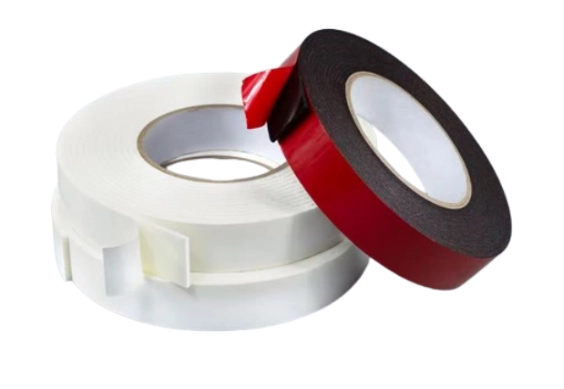
Double sided foam tape is useful when bonding surfaces are uneven, curved, textured, or exposed to vibration.
Common applications include:
- Door trim
- Decorative strips
- Interior panels
- Plastic covers
- Components with small surface gaps
The foam carrier fills small gaps. It improves contact between bonding surfaces. It adds cushioning. It reduces vibration too.
For automotive uses, check foam thickness. Look at density. Review adhesive type. Check substrate compatibility in tape selection.
4. High Performance Acrylic Adhesive Tape
High performance acrylic adhesive tapes fit jobs that need more durability. They handle temperature resistance. They support long term holding power.
Typical uses include:
- Long term trim attachment
- Components exposed to higher cabin temperatures
- Decorative parts requiring good aging resistance
- Applications under higher shear loads
- More demanding bonding environments
However, there is no universal acrylic tape for every automotive application. The adhesive should be selected according to the substrate, operating temperature, load, and environmental conditions.
Testing samples under realistic conditions is recommended before final approval.
How to Choose the Right Tape for Different Interior Materials
Different automotive materials need different bonding approaches.
ABS and PC
ABS and PC are generally easier to bond than low surface energy plastics. Acrylic adhesive tapes are commonly considered for these substrates, depending on surface finish and application requirements.
PP and PE
PP and PE have low surface energy. They are harder to bond. Standard adhesives may give good initial tack. They often lack enough long term adhesion. Special adhesives may be needed. Primers can help. Surface treatment works in some cases.
Foam, Fabric, and Leather
Flexible tissue or film based tapes often suit foam. They work for fabric. They fit leather lamination. The tape must give enough adhesion. It should avoid making the finished component too stiff.
Painted or Coated Metal
For painted or coated metal, check coating type. Look at surface cleanliness. Consider temperature exposure. Review long term holding requirements.
In every case, specific testing matters. One tape can act quite differently on various substrates.
5 Factors to Consider Before Selecting Automotive Interior Tape
1. Substrate Surface Energy
Materials such as PP and PE are harder to bond than ABS, PC, or metal. Identifying both bonding surfaces is therefore the first step in tape selection.
2. Operating Temperature
Consider assembly temperature as well as storage, transportation, and long term cabin temperatures.
3. Load and Stress
Lightweight decorative films require less holding strength than trim components exposed to continuous peel or shear stress.
4. Surface Geometry
Curved, rough, or textured surfaces may require thicker and more conformable tapes, while thin PET tapes are better suited to flat, precise bonding areas.
5. Manufacturing Process
Consider manual or automated assembly, lamination, die cutting, liner removal, positioning accuracy, and production speed.
Common Reasons Automotive Interior Tape Fails
Tape failure is not always caused by poor adhesive quality. Common problems include:
- Dust, oil, or mold release agents on the surface
- Insufficient application pressure
- Wrong adhesive selection for PP or PE
- Low application temperature
- Insufficient dwell time
- Excessive peel or shear stress
- Incorrect tape thickness
- Poor contact on uneven surfaces
Bonding areas should normally be clean, dry, and free from contamination. Manufacturers should also conduct substrate specific adhesion testing before mass production.
Custom Automotive Adhesive Tape Solutions from QKD Tape
Automotive interior projects often require customized tape constructions rather than a standard product.
As an industrial adhesive tape manufacturer, QKD Tape supports OEM and ODM solutions for automotive and industrial bonding applications.
Customization options can include:
- Adhesive system
- Carrier material
- Tape thickness
- Width and roll length
- Release liner
- Slitting
- Die cutting requirements
- OEM/ODM specifications
For accurate tape selection, buyers should share details about the bonding substrates.
Conclusion
There is no single best adhesive tape for every automotive interior trim application.
Double sided tissue tape works well for lightweight bonding and lamination. PET tape gives thin and stable bonding for precision parts. Foam tape helps with uneven surfaces and vibration sensitive components. High performance acrylic adhesive systems may be more suitable for demanding long term applications.
The right choice ultimately depends on substrate, temperature, load, surface geometry, and manufacturing process.
Contact QKD Tape to discuss your automotive interior bonding requirements or request samples for evaluation.
FAQ
Q: Can double sided tape bond automotive plastic trim?
Yes. Double sided tape is widely used for plastic trim. Adhesive compatibility is important. ABS and PC bond more easily than PP and PE.
Q: What tape is best for bonding PP automotive parts?
PP is a low surface energy plastic. It may require adhesive systems designed for hard to bond surfaces. Application testing is recommended before production.
Q: Is foam tape suitable for automotive interior panels?
Yes. Foam tape can bond interior panels and decorative trim while helping compensate for uneven surfaces and vibration.
Q: How can I prevent automotive adhesive tape from peeling off?
Clean the bonding surface, select the correct adhesive, apply sufficient pressure, use the tape within its recommended temperature range, and allow adequate dwell time before loading the bond.
Q: Can QKD Tape provide custom automotive adhesive tape?
Yes. QKD Tape supports OEM and ODM requirements, including customized adhesive systems, carriers, thicknesses, widths, roll lengths, liners, slitting, and die cutting specifications.