
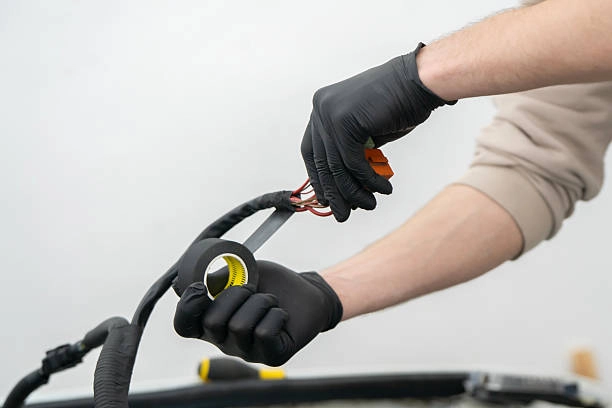
Electric vehicles have changed the job of a wire harness. It now runs beside battery modules, inverters, charging circuits, and high current cables.
Automotive wire harness tape still bundles cables and holds branches in place. In an EV, it may also need to tolerate higher heat, resist abrasion, reduce cabin noise, withstand fluids, and avoid unnecessary weight. One tape grade rarely covers every zone.
Why Are EV Wire Harnesses More Demanding Than ICE Vehicle Harnesses?
EV harnesses are not simply larger conventional harnesses. They are routed through tighter spaces, closer to heat generating electronics, and around rigid battery structures where vibration never fully disappears.
High voltage cables change the risk calculation. Damage near a high voltage route can become a safety issue and an expensive warranty claim.
EVs are quiet, too. Without engine noise masking small sounds, a cable tapping behind a dashboard becomes noticeable. A harness may pass its electrical tests and still create a poor customer experience.
Weight adds another constraint. Thick over wrapping “just to be safe” adds mass, reduces flexibility, and makes assembly harder.
Which Tape Performance Requirements Are Becoming More Critical in EVs?
The bigger change is location specific selection. Temperature near an inverter is not the same as temperature in a roof harness. Abrasion under the floor is not the same as abrasion inside a door.
Higher Temperature Resistance and Adhesive Stability
Temperature ratings need careful reading. A tape may survive a short heat peak and still lose adhesion after long thermal aging.
Typical failure signs include edge lifting, adhesive softening, flagging at branch points, and residue. These often appear after repeated hot cold cycles, not during initial assembly.
Near power electronics, charging modules, or battery thermal systems, adhesive stability matters as much as backing temperature resistance. The backing can remain intact while the adhesive slowly releases.
Greater Abrasion and Mechanical Protection
EV packaging creates hard contact points: stamped metal edges, plastic clips, corrugated tubes, battery enclosures, and narrow body passages.
PET cloth tape is often a sensible choice where repeated rubbing is expected. Still, thicker is not automatically better. Excess build can reduce flexibility, interfere with clips, or prevent a branch from seating correctly.
Wear is often concentrated at one bend or fixing point. Local reinforcement usually makes more sense than wrapping every section with the heaviest tape available.
Flame Retardancy, Insulation and Environmental Resistance
Flame performance, electrical insulation, and fluid resistance are often specified together around high voltage components.
Tape may face moisture, oils, cleaning agents, cable plasticizers, and thermal cycling. Some adhesive combinations bond well on day one but become brittle or leave residue after aging.
Tape should be treated as one layer in the protection system. Cable insulation, sleeves, conduits, clips, and routing geometry all share the load.
Noise Damping, Low VOC and Assembly Quality
Interior harness tape has a different job. It must remain flexible and prevent cable movement against hard trim surfaces.
PET fleece tape is common in these areas because its soft surface helps reduce rattling. Low odor and low VOC performance also matter in enclosed cabins.
Assembly behavior should not be ignored. Uneven unwind slows operators. Excessive tack makes repositioning difficult. Poor hand tear encourages knife use on the line. Small details, but they become production problems quickly.
How Do Tape Requirements Change Across Different EV Zones?
Inside the passenger compartment, noise damping, flexibility, and low VOC performance usually lead the decision. Around dashboards and doors, soft fleece tape often performs better than a hard abrasion focused construction.
Underbody and battery area harnesses face moisture, debris, vibration, and rigid contact points. Mechanical protection and stable adhesion matter more there.
Near motors, inverters, and charging electronics, thermal aging and fluid resistance move to the top of the list. High voltage routes may also require controlled colors and traceability.
General body harnesses still need economical bundling, but weight targets and automated wrapping now influence them as well. One “standard EV tape” for the whole vehicle is usually a purchasing shortcut, not an engineering solution.
Which Tape Backing Is Best for Each EV Wire Harness Application?
| Tape Type | Main Strengths | Typical EV Harness Use |
| PVC wire harness tape | Flexible, economical, suitable for bundling and insulation | General harness bundling and protected interior routes |
| PET cloth tape | Strong abrasion and tear resistance | Harnesses exposed to friction, vibration or mechanical wear |
| PET fleece tape | Soft surface and strong noise damping performance | Dashboard, doors and passenger compartment harnesses |
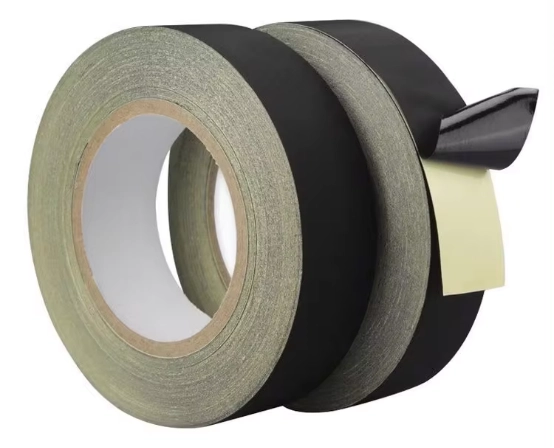
| Acetate cloth tape | Conformability and application specific electrical properties | Components or harness sections requiring specialized wrapping |
| Specialty high temperature tape | Localized heat or reinforcement performance | Selected areas near high temperature components |
What Should Engineers and Buyers Verify Before Approving an EV Harness Tape?
A datasheet is only a starting point. Approval should cover:
- Continuous and peak operating temperature
- Adhesion after heat aging and thermal cycling
- Abrasion resistance at realistic contact points
- Flame, insulation, VOC, and odor requirements
- Compatibility with cable jackets and corrugated tubing
- Resistance to moisture, oils, and chemicals
- Unwind force, hand tear, dimensions, and traceability
Samples should be tested on the actual cable set whenever possible. Peel data on stainless steel does not fully describe behavior on soft PVC jackets, cross linked insulation, or corrugated tubing.
How Can OEM/ODM Tape Customization Support New EV Platforms?
New EV platforms often create awkward combinations: a thinner harness with higher abrasion exposure, a low VOC interior tape needing stronger adhesion, or a specific color and width for high voltage identification.
OEM/ODM development allows backing weight, adhesive coat, roll width, length, color, unwind force, and packaging to be adjusted around the assembly process.
For QKD Tape, the practical value is not only supplying PVC, PET cloth, PET fleece, and other automotive tapes. It is matching those constructions to the customer’s routing zone, wrapping method, performance target, and documentation needs.
Conclusion: EV Wire Harness Tape Selection Must Be Application Specific
EV wire harness tape is becoming more specialized because the vehicle itself is more specialized. Heat, abrasion, noise, fluids, weight, and production speed now overlap in ways that older selection rules do not always cover.
Define the zone. Identify the likely failure mode. Then choose or customize the tape around that condition.
Share your operating temperature, harness location, tape dimensions and performance requirements with QKD Tape to receive a recommended material or customized OEM/ODM solution.
FAQ
Q: Can one wire harness tape be used throughout an electric vehicle?
Usually not. Interior, underbody, battery, and power electronics zones expose tape to different temperatures, noise requirements, chemicals, and abrasion levels.
Q: Is PET cloth tape always better than PVC tape for EV harnesses?
No. PET cloth offers stronger abrasion resistance, while PVC may be better for flexible, economical bundling in protected areas.
Q: Why is low VOC performance important for interior harness tape?
Tape is used in enclosed cabin spaces. Odor or emissions that seem minor during production can become noticeable after the vehicle sits in heat.
Q: What information is needed for a custom harness tape?
Provide the installation zone, temperature range, cable jacket material, required dimensions, abrasion level, flame or VOC targets, wrapping method, and expected volume.