
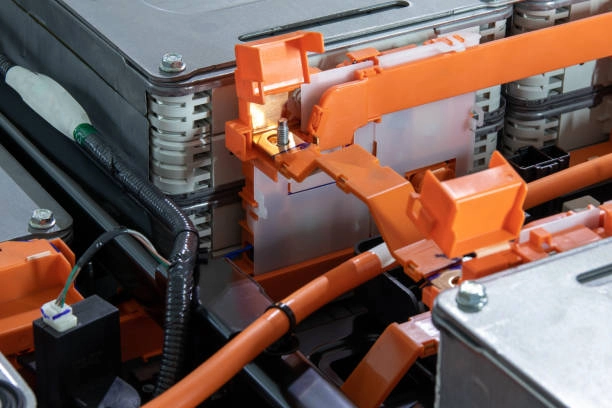
An EV battery pack is a tight assembly of live conductors, cell cans, busbars, sensors, cooling parts and structural materials. A damaged insulating layer can become a short circuit under vibration.
Electrical insulation tape for EV battery packs has to stay bonded while voltage, heat, moisture and mechanical stress change around it. The grade must remain bonded and electrically stable through service.
What Is Electrical Insulation Tape for EV Battery Packs?
EV battery insulation tape is an engineered electrical barrier. It is built from a carrier film or fabric and an adhesive system selected for a defined temperature, voltage and surface condition. PVC, PET, polyimide and glass fiber tapes all have useful places in battery construction.
PVC tape is flexible and easy to handle. PET tape offers good dimensional stability and abrasion resistance. Polyimide is used where temperatures rise sharply. Glass fiber tape adds reinforcement when an edge or joint needs extra mechanical support. A PVC insulation tape solution may suit a low-profile harness wrap, while a PET construction can be better around a busbar with repeated movement.
The carrier is only half of the decision. Adhesive chemistry, thickness, liner release and converting quality can change the result on the production line.
8 Key Properties Engineers Should Evaluate
The properties below interact. A tape with excellent dielectric strength can still fail if it cannot wet out on the substrate. A highly aggressive adhesive may create rework problems. Evaluation works best when the tape is tested in the same assembly conditions used for the pack.
1. Dielectric Strength and Insulation Resistance
Dielectric strength indicates how much voltage the tape can withstand before breakdown. Insulation resistance shows how effectively it limits leakage current. Both values matter around high-voltage busbars and module interconnects.
Check the test method, specimen thickness and conditioning behind the number. A rating measured on a clean laboratory sample may not represent a tape stretched over a stamped metal edge. Voltage margin should match the pack design, including transient events. Test the finished wrap or die-cut part.
2. Temperature Resistance and Thermal Aging
Fast charging and high-load driving push heat into cells and conductive joints. Local hot spots can be higher than the average pack temperature. Tape must retain adhesion and insulation through steady heat, short peaks and repeated thermal cycling.
Review continuous temperature capability alongside short-term resistance. Thermal aging can make an adhesive brittle or reduce its holding power. Cycle tape on the actual substrate, then inspect adhesion and insulation.
3. Flame Retardancy and Fire Safety
Thermal runaway changes the safety equation. Insulation tape cannot stop a cell failure, but a flame-retardant construction can limit flame spread and keep adjacent conductors separated for longer.
Ask for the applicable UL, IEC or automotive test information. Look at self-extinguishing behavior, smoke and residue. The adhesive deserves attention too; a carrier may resist flame while the adhesive softens and flows. Select the grade with the pack safety engineer.
4. Adhesion to Battery Pack Materials
Battery assemblies combine smooth copper, anodized aluminum, coated steel, plastics and textured molded parts. Surface energy changes from one component to the next. Dust and traces of coolant make the problem harder.
Measure initial tack, peel adhesion and shear strength on the real substrates. Repeat the tests after heat and humidity exposure. A tape that holds on PET film may not hold on a powder-coated bracket. Adhesive selection also affects removal. During service or rework, clean removal can be as valuable as maximum bond strength.
5. Conformability and Application Flexibility
Space inside a module is rarely generous. Tape may need to turn around a radius, cover a weld tab or follow a narrow channel without wrinkles. Stiff material bridges the corner and leaves an air gap. Excessive stretch can thin the insulation.
Look at flexibility, elongation and recovery after application. Die-cut parts should sit flat and release cleanly from the liner. For hand application, controlled tearability helps technicians work quickly. Automated lines need predictable unwind and placement. A tooling trial reveals fit quickly.
6. Mechanical Strength, Abrasion and Puncture Resistance
Vibration, busbar edges and assembly tools can attack the insulation mechanically. A nick made during module insertion may not be visible, yet it can become a failure point later.
Tensile strength and elongation describe how the tape behaves under pull. Abrasion and puncture resistance describe what happens when parts rub or press against it. PET suits stable wraps; glass fiber adds reinforcement. Edge protection may need a thicker or die-cut construction.
7. Chemical and Electrolyte Resistance
A battery pack can contain electrolyte residues, coolant, cleaning fluids and condensation. The tape should keep its bond and dielectric properties after contact with the chemicals expected in service.
Use immersion or spot-exposure tests based on the actual fluid list. Include elevated temperature in the test. Inspect for swelling, discoloration, adhesive transfer and loss of peel strength. Compatibility is a system issue: the same adhesive can behave differently on a coated metal surface and a polymer housing.
8. Thickness, Dimensional Stability and Process Compatibility
Thickness affects clearance, creepage distance and the amount of space available for cooling or compression. Tight tolerance matters when several insulating layers stack inside a confined module.
Specify nominal thickness and allowable variation. Check dimensional stability after heat exposure. On a converting line, liner release, slitting accuracy and die-cut registration influence output. Consistent rolls reduce stoppages and help keep operator settings stable. QKD Tape can support custom die-cut tape manufacturing when a standard roll does not fit the assembly sequence.
How to Select the Right Tape for Your EV Battery Application
Start with the electrical and thermal envelope: maximum voltage, transient voltage, continuous temperature and hot-spot temperature. Map every surface the tape will touch. Record whether the application is a harness wrap, busbar barrier, cell edge protector or module closure.
Then define mechanical and chemical exposure. Decide whether the line needs hand tear, machine dispensing, slit rolls or pre-cut shapes. Build a small test matrix and age samples before a vehicle-level trial. Request traceability, thickness tolerance and batch data.
A capable converter can adjust width, adhesive coat weight, liner and packaging around the process. This helps as a design moves into volume production.
Why Work with QKD Tape for EV Battery Insulation Solutions?
QKD Tape supplies industrial adhesive products for automotive and electrical assembly applications, including PVC tape, PET tape, double-sided tape and glass fiber tape. Engineers can discuss the complete construction for the application.
Width, roll length, thickness, adhesive behavior and die-cut geometry can be developed for the application. OEM and ODM support can include packaging and labeling. For a new pack, sharing the substrate list, temperature profile and assembly method gives the technical team a workable starting point. Review the industrial adhesive tape and request samples before design freeze.
A tape decision should survive production reality. If you are comparing materials for a new EV battery pack, contact QKD Tape with the voltage, temperature and surface requirements. Early sample testing exposes issues at low cost.
FAQ
Q: What tape is commonly used for EV battery insulation?
PET, PVC, polyimide and glass fiber tapes are common choices. The best option depends on voltage, temperature, surface, mechanical stress and required certifications.
Q: Is ordinary electrical tape suitable for a battery pack?
Not automatically. Household or general-purpose tape may lack the thermal aging, flame, chemical and process performance required inside an EV pack.
Q: How thick should EV battery insulation tape be?
There is no universal thickness. Engineers should balance dielectric margin and puncture resistance against clearance, creepage distance and assembly space.
Q: Can insulation tape be die-cut for battery components?
Yes. Die-cut barriers, tabs and edge covers can improve placement accuracy and reduce assembly time. The shape should be developed with the liner and dispensing method in mind.
Q: What information should be sent when requesting samples?
Provide operating voltage, temperature range, substrate materials, expected chemical exposure, tape dimensions and application method. Photos or a simple drawing of the joint can also speed up material selection.