
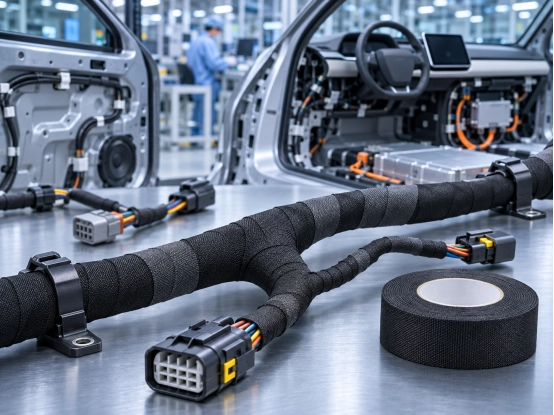
A new EV cabin smells like almost nothing — deliberately. OEMs now budget for what an interior releases; every tape on a bundle counts toward that total. Low VOC automotive tape is the practical answer, and PET cloth wire harness tape is where most programs start.
Why Low-VOC Wire Harness Tape Matters in EV Interiors
Improving In-Cabin Air Quality
A VOC is a carbon-based chemical that evaporates at ordinary temperatures — the kind hiding in adhesives, foams, soft plastics. Harness tape reads small next to trim and foam, yet it sits inside a sealed cabin for the life of the car — which is why a verified low-VOC construction matters: it drops a line item out of the air-quality total.
Meeting the Needs of Modern Electric Vehicles
What happens when the powertrain goes quiet? Faint chemical smells surface — ones a combustion car would have masked. A cable rattle that used to hide under engine noise is now audible. So the tape has to answer on emissions, odor, and noise at once. EV interior materials reviews now reach small adhesive components because of it.
What Makes a Wire Harness Tape Low in VOC?
Backing Materials and Adhesive Formulation
Backing is the starting point, though — woven PET cloth, PET fleece, and PVC film don’t carry the same resin or finish load. What about the adhesive? It shifts with each solvent or additive decision. And process decides what survives roll after roll: coating temperature, cure schedule, batch control. A spec sheet won’t settle it. Test the finished tape.
Low Odor vs. Low VOC
Same thing? Not quite. Low odor is a sensory judgment — how strong a smell reads. Low VOC is a lab number — compound concentration in air, independent of how anything smells. One can pass while the other misses: clean on the bench, flagged by a panel. So the program needs both records, kept separate.
Key Performance Requirements for EV Wire Harness Tape
Emissions are only half the spec — a tape that lifts at the first bracket still fails the vehicle.
Low VOC Emissions and Odor Control
- Emission data for the finished construction, not the raw adhesive
- Odor assessment at the program’s test temperature
- Compliance documentation per ISO 12219-2 or the OEM spec
Abrasion Resistance and Mechanical Durability
Along a dash, a bundle crosses brackets, clips, and stamped edges, and the wrap takes that friction for years. What must the tape do at those contact points? Hold its ground — resist abrasion, flex through tight radii, and keep a bond that won’t walk.
Adhesion, Flexibility and Temperature Resistance
Initial tack matters where wraps happen by hand or at machine speed. Then the temperature question: can the adhesive hold from a -40 °C night to a 105 °C summer dash? And can it unwind at controlled tension so overlaps stay even? Miss one and the field shows it — lifted ends, frayed bundles, rework claims.
Noise Reduction and Vibration Damping
Inside a door panel, a free cable segment is a rattle source — a fabric-backed tape damps the bundle’s movement and friction against trim. In an EV cabin, quiet enough to hear a loose cable, that acoustic role is part of the spec, not a bonus.
Choosing the Right Tape Material for EV Cable Bundles
No single backing wins every position — match the tape to the zone.
PET Cloth Wire Harness Tape
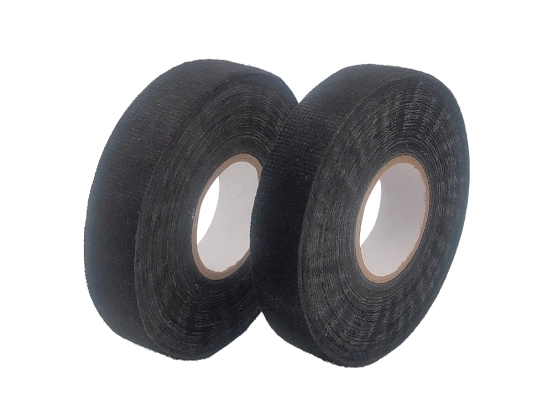
A woven cloth backing gives abrasion resistance without stiffness, flexing around branch points with strong initial tack and clean removal. That is why PET cloth leads interior EV shortlists where low odor and VOC are verified.
PET Fleece Wire Harness Tape
Soft, with a textile surface that mutes movement. PET fleece wire harness tape suits dashboard and door-panel runs where vibration damping leads and a hand-tear speeds the wrap; a lighter build may not match cloth where metal edges rub constantly.
PVC Wire Harness Tape
PVC is flexible and cost-effective, and correctly specified PVC wire harness tape adds insulation where the spec calls for it. But is it low-VOC? Not automatically. An interior EV application needs its own test data before any approval.
The shortlist comes down to install position: emission limit, abrasion duty, noise target, removal needs.
How to Select and Test Low-VOC Wire Harness Tape
Three checks separate a qualified tape from a plausible one.
Check VOC and Odor Test Reports
Which reports matter? Emission data for the finished tape — backing and adhesive together, not the adhesive alone — plus the test standard used, with odor and fogging filed as separate entries.
Evaluate Mechanical Performance
What to screen first? Adhesion to the real cable jacket and abrasion resistance. Then tensile strength, unwinding force, temperature range, residue. A construction that leaves residue on a jacket can fail an interior job despite a clean emissions report.
Test Samples Under Real Application Conditions
Coupon data screens; the application decides. Wrap a real harness segment along the production routing, age it at the program’s temperature profile, then re-check adhesion. With two or three left, request samples and a full data package.
QKD Tape’s Low-VOC Wire Harness Tape Solutions for EV Applications
PET Cloth Wire Harness Tape for Automotive Applications
QKD Tape’s PET cloth construction covers the list above — low-odor, low-VOC adhesive, woven backing, strong initial tack, abrasion resistance, aging stability, clean removal. Two models cover most interior harness work:
| Model | Total Thickness | Application Temperature |
| QKD-8025C | 150 μm | -40 °C to 105 °C |
| QKD-8026A | 250 μm | -40 °C to 105 °C |
The 150 μm 8025C suits routine bundle protection; the 250 μm 8026A adds wear margin where the route is rougher. Final selection follows your own testing.
Customized Adhesive Tape Solutions
What can be adjusted? Width, thickness, adhesive formulation, backing — drawing on fifteen-plus years of tape manufacturing and 200+ developed adhesive formulations, with OEM/ODM support and samples. Custom adhesive tape solutions start from the OEM’s specification.
Contact QKD Tape for specifications, samples, and a customized low-VOC wire harness tape solution for your EV program.
Frequently Asked Questions About Low-VOC Wire Harness Tape
What Is Low-VOC Wire Harness Tape Used For?
Harness securing, cable bundling, interior wiring protection — anywhere an EV interior needs a low-emission, low-odor hold, selected against emission limits instead of tack alone.
Is PET Cloth Tape Suitable for EV Interior Cable Bundles?
Often yes. The woven backing flexes around branches, resists abrasion at brackets, and can be specified low-odor with verified low-VOC performance. Just keep “verified” in mind — the finished construction needs testing against the OEM’s spec before release.
How Can I Choose the Right Low-VOC Automotive Tape Manufacturer?
Start with product consistency across batches, plus VOC and odor documentation for the finished tape. Then weigh customization capability, sample availability, manufacturing experience — a supplier that hands over test reports with the sample is worth the extra week.
Conclusion: Find the Right Low-VOC Wire Harness Tape for Your EV Projects
Low VOC, abrasion resistance, flexibility, stable adhesion — an EV interior puts all four on one short tape. QKD Tape’s PET cloth wire harness tape covers the combined requirement, and customization keeps the match route-specific. Looking for reliable low-VOC wire harness tape for your EV projects? Contact QKD Tape today to discuss your application requirements and request customized adhesive tape samples.