
Pull a phone display off the line and you’ll find a couple of tiny bonding pads, each in the same spot as the unit before it. Off the roll, the first hundred are fine, then it drifts: a pad a touch wide, a few in the scrap bin. That’s the cost of standard tape on a fast line. Custom die-cut adhesive tape is the fix — bonding, insulation, and part protection in shapes that already fit. We make industrial adhesive tape at QKD Tape, and die-cutting is where we do our best work.
What Is Custom Die-Cut Adhesive Tape?
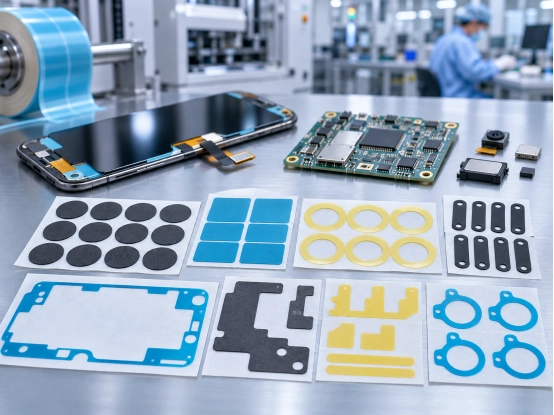
This is the tape you already know, cut before it reaches the floor. Instead of a roll on the bench, the workstation gets a part that’s ready to place.
Understanding the Die-Cutting Process
A die stamps tape into whatever geometry the job calls for — a circle, a ring, a contour that wraps the part. The trickier the shape, the harder the cutting method has to work, which is why accuracy is something you state up front. Parts arrive on release liners, which keep the adhesive clean until application.
Work from a roll and every piece is a fresh cut placed by hand. A die-cut piece arrives the right size, so placement stops depending on who’s cutting.
Why Electronics Manufacturers Choose Die-Cut Tape
On a repetitive line, the operator never cuts or positions by hand again. Accuracy holds from piece one to piece ten thousand, trim drops, and the step gets easier to run. That’s why die-cut tape for electronics is now standard on busy lines.
Common Applications of Die-Cut Adhesive Tape in Electronics Assembly
In machine electronics assembly, the tape does one of three jobs: it holds a part down, shields a surface while processing runs, or keeps live conductors apart.
Electronic Component Mounting and Bonding
Holding things in place: the tape mounts small components, seats displays and protective panels, attaches light plastic and metal parts, and bonds the internals inside a housing. The shape matches the part, so each piece drops into one position — no nudging.
PCB Protection and Process Masking
Boards go through hot and wet steps before they’re done. Some areas need covering during soldering and plating; other surfaces just need temporary protection. Our PET silicone tape rides through those conditions, resists the chemistry it meets, and peels off clean.
Electrical Insulation and Component Protection
Custom shaped tape insulates specific components, shields sensitive surfaces, and covers the areas that need it. One boundary: on any electrical job, the tape’s voltage rating and dielectric performance have to cover the application — bonding strength alone doesn’t cut it.
Choosing the Right Adhesive Tape Material for Die-Cutting
The shape gets the part there. The material keeps it.
PET Film Tape for Precision Applications
PET film is what we reach for on precision work. It’s thin and light, holds its dimensions, and the right grades give you solid insulation. The adhesive is the movable part — the same backing can carry different formulations. If the part will see solder or curing heat, look at the PET silicone variant.
Double-Sided Acrylic Foam Tape
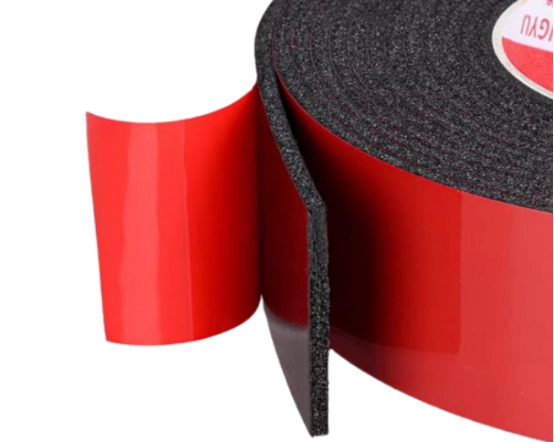
When the joint moves, foam wins. Our double-sided acrylic foam tape soaks up the shock and kills the vibration, and its backing bends around a surface instead of skipping over the bumps a rigid adhesive would ride past. Where the surfaces suit it, the bond holds hard.
Double-Sided Tissue Tape
Our double-sided tissue tape is the thin, flexible option — low profile bonds are its thing. One caution: adhesion strength is rarely the whole reason a material wins or loses. On a real job, look at the bonding surface, the working environment, and the thickness budget first.
Key Factors to Consider When Designing Custom Die-Cut Tape
Designing the part is a small engineering job, not just cutting a roll into a different shape. Four decisions decide whether it survives the line.
Shape, Dimensions and Cutting Accuracy
Length, width, thickness come first, and they should come with a CAD drawing or a physical sample — we’d rather measure than guess. Holes, notches, tabs, and contours belong on the drawing too, with tolerances and cutting registration stated. Miss a tab by half a millimetre and the part won’t sit in the housing.
Adhesive Strength and Surface Compatibility
The surface comes before the adhesive — metal, plastic, and glass each grip differently, and surface energy and texture decide what holds. Acrylic and silicone cover most electronics cases; you balance tack, peel, and holding power against how the part gets loaded.
Temperature and Environmental Resistance
What will the joint see? Operating temperature, solder, cure, storage — and what’s in the air: moisture, chemicals, humidity. Put all of it in the spec, along with adhesive aging and long term stability. A room temperature bench sample tells you almost nothing about a board that cycles through solder heat.
Release Liners and Application Requirements
Treat the liner as part of the design — it has to work with the adhesive. If an operator is peeling by hand, easy peel edges matter. If a machine is doing it, the liner has to run clean through a dispenser. Individual pieces or a continuous web — that choice sets the tooling.
From Design to Production: How Custom Die-Cut Tape Is Made
It runs in order, with a checkpoint at each step. Application assessment comes first — the component, the surface, the environment. Material selection picks the backing, adhesive, and liner. The drawing then locks down dimensions, shape, and the cut. We make a sample and test it for adhesion, dimensions, removal, and environmental resistance. Mass production starts once the spec is confirmed. And here’s the step people skip: run the sample through a real assembly before you commit to volume — a design that’s perfect on paper can still fight the fixture.
Why Choose QKD Tape for Custom Die-Cut Adhesive Solutions?
Multiple Adhesive Tape Materials for Electronics
Everything above comes off our line and can be die-cut. For holding jobs, double-sided acrylic foam tape; thin bonds, double-sided tissue tape; high temperature precision work, PET silicone tape; electrical protection where it fits, PVC electrical insulation tape.
Customized OEM/ODM Manufacturing Support
We run an OEM/ODM side so the part follows your drawing, not our catalog. Dimensions, shapes, backings, adhesives, colors, and specs get made to order, with sample development and technical consultation included. Fifteen plus years in manufacturing and 200 plus developed formulas mean most of the shapes you’ll ask for, we’ve already cut.
Better precision, consistent bonding, less manual work, customization to the application — that’s what die-cut tape adds to electronics. For the custom solution, the samples, and OEM/ODM support, QKD Tape takes it from drawing to production.
Looking for custom die-cut adhesive tape for your electronic products? Contact QKD Tape to discuss your design requirements and request application specific samples.
Frequently Asked Questions About Custom Die-Cut Adhesive Tape
What Is Die-Cut Adhesive Tape Used For in Electronics?
Wherever the shape has to match the part — holding components, protecting a PCB during processing, insulating a surface.
Can Double-Sided Tape Be Custom Die-Cut?
Yes. If the grade can be converted, we’ll cut it to your dimensions and shapes, built around your assembly.
What Information Is Needed for a Custom Die-Cut Tape Order?
A drawing with dimensions and backing, the bonding surface, the operating temperature, and the application method — by hand or on a machine.